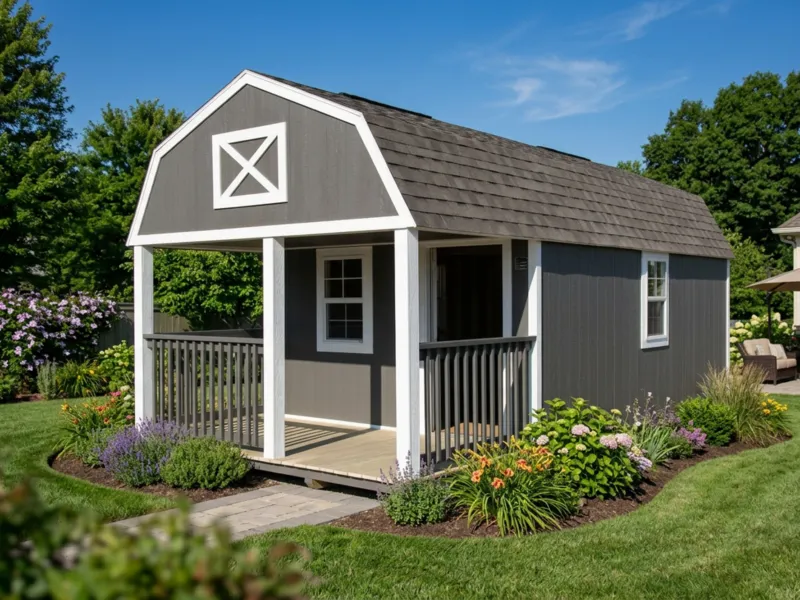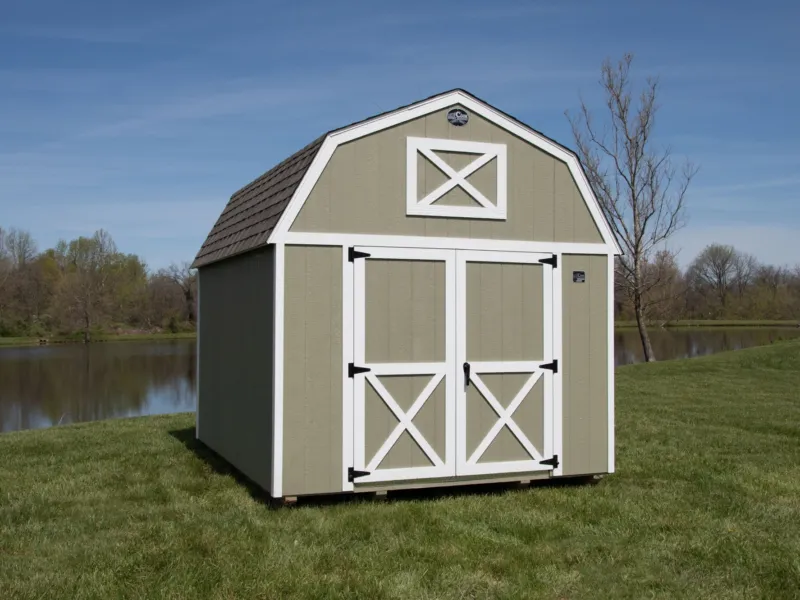
The right shed size comes down to two things: what you’re putting inside, and how much room you need to move around it. Hand tools and a push mower fit an 8×8 to 8×12; a riding mower or a workshop wants a 10×16; a lawn-care fleet or a big workshop needs a 12×20 or larger. Cook builds every footprint from 6×6 up to 12×32.
Start with what’s going inside
The fastest way to size a shed is to list the biggest things going in it, then add room to walk around them. A shed packed wall to wall is a shed you can’t use — plan on filling about two-thirds of the floor and leaving the rest as working space. Use this as a starting point:
| What you’re storing | Recommended footprint | Square feet |
|---|---|---|
| Hand tools, bikes, a push mower | 8×8 – 8×12 | 64–96 sq ft |
| Riding mower + yard tools | 10×12 – 10×16 | 120–160 sq ft |
| Backyard workshop (bench + clearance) | 10×16 – 12×20 | 160–240 sq ft |
| She-shed, home office, or studio | 8×12 – 10×14 | 96–140 sq ft |
| Motorcycle, ATV, or garden gear | 8×12 – 10×12 | 96–120 sq ft |
| Tractor, UTV, or large equipment | 12×20 and up | 240+ sq ft |
| Lawn-care fleet or a large workshop | 12×24 – 12×32 | 288–384 sq ft |
Match the width to the job
Cook builds four widths, and width usually matters more than length:
- 6 feet wide — the Lean-To’s narrow footprint slips through a standard 8-foot gate. Built for tight side yards, firewood, pool equipment, or a backyard chicken coop.
- 8 feet wide — the most economical general-storage width. Room for tools, a mower, and shelving without taking over the yard.
- 10 feet wide — the sweet spot for a riding mower, a workshop bench with walking room, or a comfortable she-shed.
- 12 feet wide — the widest we can deliver in one piece. Room for big equipment, a full workshop, riding gear behind an overhead garage door, or a finished cabin.
Portable buildings top out at 12 feet wide because they’re built off-site and delivered whole on a trailer — length is where the larger buildings grow.
Leave room to move
Two feet of clearance around your equipment turns a storage box into a space you can actually work in. A riding mower might be 6 feet long, so a 10×12 stores it — but a 10×16 lets you park it, hang tools on the wall, and still reach the workbench. When you’re caught between two sizes, size up: the price difference is smaller than the frustration of a shed you outgrow in a year.
Check your site and access before you order
Size isn’t only about what fits on the pad — it’s about what fits down the driveway. Cook delivers on a truck and trailer roughly 50 feet long that needs about 14 feet of height and width clearance and a mostly level spot. Measure gates, overhead wires, and tight corners before you settle on a footprint. Your local dealer will do a free site check to confirm everything before delivery.
See real prices by size
Every Cook footprint has its own page showing the exact cash price for each style built in that size. Compare all the styles on one footprint — 8×12, 10×16, 12×20, or 12×24 — or browse every style at Shed Styles.
Frequently Asked Questions
What size shed do I need for a riding mower?
Plan on at least a 10×12 for a riding mower, and a 10×16 if you also want room for a bagger, tools, or a second mower with space to walk around. The extra depth means you're not backing the mower out every time you need something stored behind it.
What's a good all-around shed size?
A 10×16 or 12×20 handles most backyards — big enough for a mower, tools, and a small workbench without dominating the yard. If you're unsure, size up: it's easier to grow into a shed than to outgrow one.
What size shed do I need for a workshop?
For a real workshop, start at 10×16 and go up to 12×20. You'll want room for a bench along one wall, clearance to turn around with a sheet of plywood, and space for tools and materials. The 12-foot width gives you the most flexible layout.
What's the biggest shed Cook builds?
The largest standard footprint is 12×32 — 384 square feet. Twelve feet is the widest a portable building can be, because it's built off-site and delivered in one piece on a trailer; length is where the bigger buildings grow.
Do I need a permit for my shed?
It depends on where you live. Many areas don't require a permit for smaller sheds, but setback rules, HOA covenants, and size thresholds vary by county and city. Check with your local zoning office before you order — your Cook dealer can point you in the right direction.
Still not sure?
Your local Cook dealer sizes buildings every day and can walk your space with you. Find your dealer or browse all shed styles to see what fits.